A practical routine for a busy premises.

Fire safety logbook for small businesses

Bring daily management, planned checks and outstanding faults into a record your team can find. Keep the useful history together without juggling loose sheets and separate action lists.

Create your account and save your first entry free. No card required. Ongoing online recording requires a paid plan.

Prefer a printable record? Request the free full logbook PDF/Word pack by email. The free download is the complete logbook, including checks, training and defect records.

New customer annual offer: £49 for your first year, then £59/yearOr £5.99/month · per premises · automatic renewal until cancelled

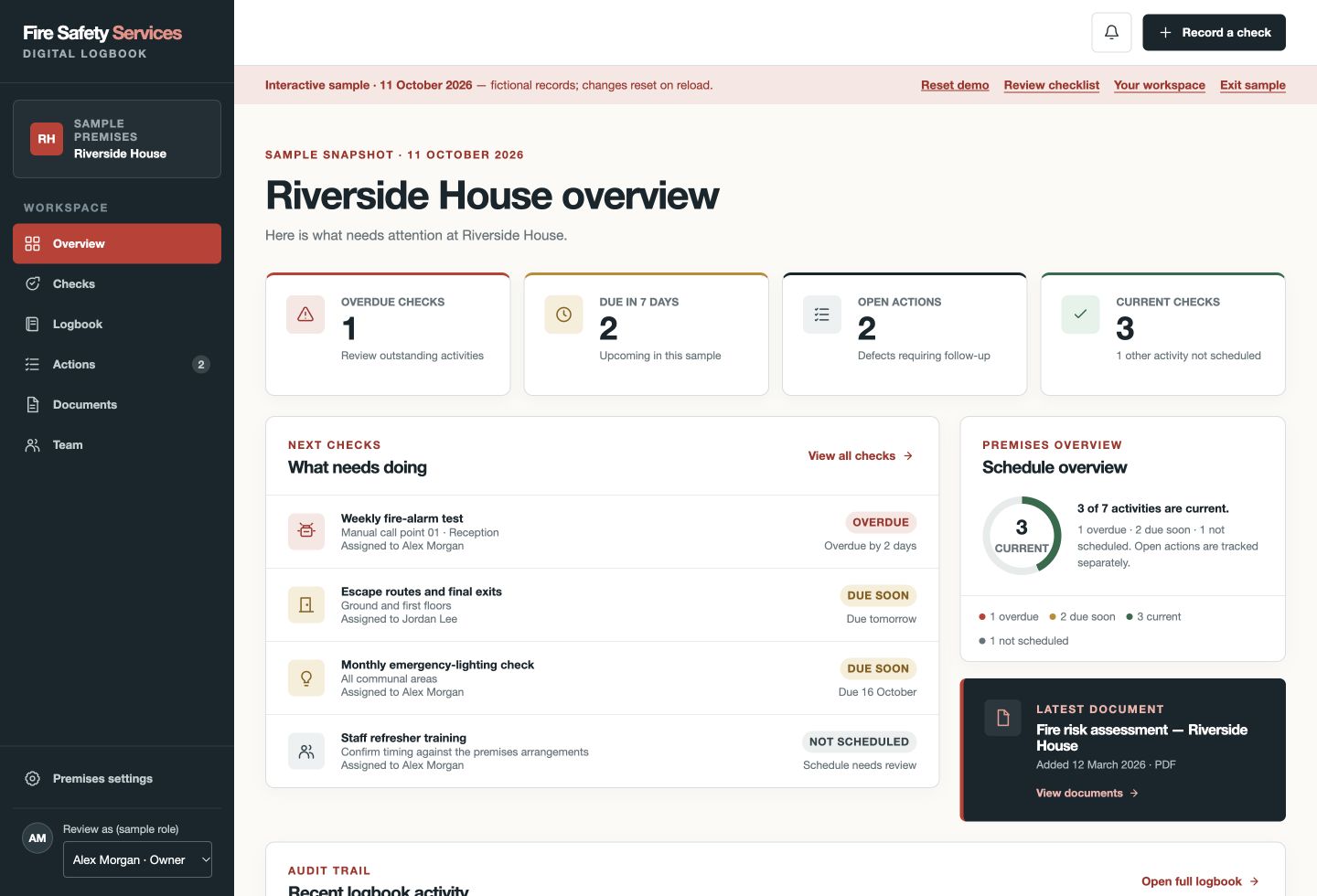
Actual digital logbook demo showing due checks, open actions and the premises overview.
Actual app screen · fictional sample premises, not customer results

At a glance

Build a record your team can keep current

The online product is available to UK users. This site’s fire-safety guidance primarily addresses England; apply the duties and system requirements relevant to your premises.

  • Choose the topics and schedules that match your premises—not every possible check.
  • Give staff clear recording and escalation responsibilities.
  • Keep contractor servicing and training evidence alongside routine entries.
  • Use one premises plan, with one genuine entry free before paying.

Match the record to the premises

The same principles, different day-to-day records

An office, a shop, a café and a salon all need a record suited to their actual risks and arrangements. The examples below identify practical priorities, not a complete compliance checklist or a fixed testing schedule.

Offices and shared workspaces

Records: Keep relevant alarm, lighting, route and door records, staff induction and drill observations together with the resulting actions.

Coordinate: Agree which systems the landlord maintains and how your team receives reports or raises a shared-building fault.

Shops and independent retail

Records: Record the areas actually checked, escape-route concerns, equipment observations and relevant staff instructions.

Coordinate: Make opening, closing and shift handovers clear. A back-room defect needs a named follow-up even if the front-of-house check was satisfactory.

Cafés and small food businesses

Records: Keep relevant fire-safety records and competent maintenance evidence for the arrangements identified by the FRA.

Coordinate: Coordinate with specialist kitchen and extraction providers where required. The app is not a kitchen suppression monitor, cleaning certificate or food-safety system.

Salons and personal-service premises

Records: Keep relevant check results, training, changes to working arrangements and defects traceable to the actual premises.

Coordinate: Use the FRA and competent advice for products, processes and equipment. Do not treat a generic salon label as confirmation that the risks have been assessed.

Practical record keeping

What should a small-business fire-safety record include?

Start with the routine your assessment and premises arrangements call for. Good records show what was done, who did it, what was found and who is dealing with anything outstanding.

01

Premises and responsibility

Identify the business premises, relevant contacts and who controls shared areas or systems. Record the scope you manage instead of assuming the landlord or a service contractor is responsible for everything.

02

Planned checks and actual results

Select relevant alarms, lighting, routes, doors and equipment. Use the agreed procedure and actual activity date. A due-date reminder or an entry marked not completed is not evidence that a check happened.

03

Staff induction, refreshers and drills

Record the real session or exercise, people involved and gaps needing follow-up. Keep attendance evidence and premises-specific instructions available; a generic course certificate is not the whole training record.

04

Service reports and supporting files

Keep relevant contractor reports, inspection findings and selected photographs with their context. Distinguish a visual observation by staff from competent servicing or technical inspection.

05

Faults, controls and follow-through

Record the location, observation, immediate escalation and action needed. Give the follow-up a responsible person and suitable target, and retain the eventual verified outcome. Urgent action must not wait for an app reminder.

06

Changes, reviews and handovers

Keep relevant information when the layout, staff roles, equipment or use changes. Share open issues during shift or manager handovers, retain earlier records and review whether the FRA or arrangements need updating.

A record you can follow

Turn an opening check into a useful team handover

This fictional shop example separates removing an obstruction from addressing the storage practice behind it. It is not an assessment of a real premises.

Illustrative record · not an app screen or customer record

Small shop · escape-route check

Activity date
29 October 2026 · example
Performed by
Opening supervisor · fictional
Routes / areas checked
Stockroom route and rear final exit
Routes clear and usable?
No · delivery trolley obstructing route
Final exits openable as intended?
Yes · within check scope
  1. Record

    Describe what was actually found

    Identify the route, performer, outcome and immediate response. Keep the failed observation even after the obstruction is removed.

  2. Action

    Agree the follow-through

    Review the Issue found action, the manager responsible and the appropriate target. Record the storage change and briefing that are still needed.

  3. Evidence

    Keep the later verification

    On a paid plan, retain selected supporting evidence and record the verified outcome. A later routine check is a separate activity, not a replacement for the original issue.

  4. Export

    Keep the record accessible

    Download the recorded logbook as PDF or Excel for a review or manager handover. Keep relevant contractor and training documents available alongside it.

Use the existing free PDF/Word pack for manual records, or choose the digital app for connected ongoing checks, actions and selected evidence. The subscription price is per premises, not unlimited business locations.

Try a real record for your premises

One genuine entry free, without a card. Ongoing online recording and supporting evidence require a paid plan.

Example: a small shop’s blocked stockroom exit: scope and recording notes

This fictional retail example separates correcting an immediate obstruction from checking that the storage practice has improved.

Illustrative example · not a completed assessment or test
Activity
An instructed escape-route check at a fictional independent shop.
Area
Stockroom route to the rear final exit.
Observation
A delivery trolley obstructed the intended route; the checker selected Issue found.
Immediate response
The obstruction was reported and removed under the premises arrangements; the manager reviewed the implications.
Action
Agree a delivery-storage position and brief the team so the problem does not recur.
Verification
Record the later review and outcome. A subsequent satisfactory routine check does not silently replace the original issue.

Start without a sales call

From your first entry to a working routine

  1. 01

    Set up the business premises

    Create and verify your account, add the actual premises and choose relevant topics. Match schedules to the FRA, equipment instructions and competent advice.

  2. 02

    Try one genuine activity

    Use Record a check for a real activity, entering the performer, area, result and notes. The first premises entry is free without a card; practice separately in the account-only fictional demo.

  3. 03

    Keep the team and history connected

    Choose a paid premises plan for ongoing recording, selected evidence and optional reminders. Use appropriate named-user permissions, review open actions and export the recorded logbook as PDF or Excel.

Get your digital logbook Full demo (free account)

Create your account and save your first entry free. No card required.

Your digital fire safety logbook

After the assessment, keep everyday records moving

An FRA and a logbook do different jobs. Use the assessment to inform your arrangements, then keep routine checks, faults and supporting evidence organised for this premises.

Built for ongoing record keeping
Compare the record-keeping options
What you needFree Word/PDF templateManual records, managed by youDigital logbookChecks, actions and evidence together
Day-to-day premises recordsAdapt the free logbook template and manage your own files.Use a guided premises logbook for checks, actions and supporting evidence.
Follow up faultsMaintain your own action list and follow-up process.Track corrective actions through progress, resolution and archiving.
Keep supporting evidenceOrganise photographs and certificates alongside your documents.Keep evidence with the premises and link it to records or actions.
Download your recordsPrintable PDF and editable Word template.Full recorded logbook in PDF and Excel, plus JSON and CSV exports.

New customer annual offer: £49 for your first year, then £59/yearor £5.99/month · per premises · automatic renewal until cancelled

Team access, supporting documents and photographs, optional reminders, and PDF/Excel exports.

No card is required for your first genuine entry. Ongoing recording requires a subscription; the full fictional demo is included with your free verified account. A logbook does not replace an FRA, competent maintenance or the action your premises needs.

Know what the record does—and does not do

Simple records without oversimplifying fire safety

Small does not mean exempt from fire-safety duties

The duties depend on the premises and circumstances, not on whether the business has a large team. Where the Fire Safety Order applies, keep the completed FRA and relevant arrangements recorded. Buying software neither performs the FRA nor guarantees compliance.

Keep shared-building responsibilities visible

Your landlord may arrange common alarm maintenance while you manage local arrangements and staff training. Establish the actual boundaries and communication route. A lease or outsourcing agreement should not be assumed to remove every responsibility.

Choose access to match people’s jobs

Use named accounts rather than a shared staff password. Owner, Staff and Viewer permissions support different levels of access; they do not assess a person’s competence or make every employee responsible for technical work.

Understand the premises plan

The new customer annual offer is £49 for the first year, then £59/year per premises, or £5.99/month per premises. Plans renew automatically until cancelled. The first genuine entry is a taster, not unlimited free recording, and one subscription does not cover every branch of a multi-site business.

Before you choose

Fire safety logbook for small businesses FAQs

Does a small business need to buy a fire safety logbook?

You do not have to buy this app or one particular branded book. You need suitable arrangements and the records relevant to your premises. A controlled paper or document system can work; a digital logbook can help a team keep activities, faults and supporting evidence connected.

What if our business has fewer than five employees?

Do not use the old five-employee threshold as a reason not to record the FRA. In England, responsible persons under the Fire Safety Order must record the completed FRA and fire-safety arrangements. A logbook supports ongoing records but is not itself the FRA.

Can we use it for an office, shop, café or salon?

Yes, where the existing recording topics and workflow suit the actual premises. Select relevant topics rather than treating a business category as an assessment of your risks. The app is not a specialist kitchen, process-safety or equipment-monitoring system.

Can staff record checks while the manager reviews actions?

The app supports named Owner, Staff and Viewer roles. Grant permissions appropriate to each person and agree who records activities, reviews faults and verifies outcomes. Assigning an account role does not establish competence or replace instruction.

Our landlord handles the fire alarm. What should we record?

Clarify who controls and maintains the system, obtain the relevant information and agree how faults are reported. Keep records for the checks and staff arrangements you actually carry out. Do not claim a landlord’s service visit or the whole building’s systems were checked by your team if they were not.

Is there a free small-business fire safety logbook template?

The existing full PDF and editable Word logbook pack is free by email with subscription consent. It includes routine checks, training, defects and actions; it is not a separate industry-specific pack. You can unsubscribe from future subscription emails. The digital app is separate, with one genuine premises entry free and ongoing recording paid.

What happens to our saved record if we do not subscribe?

The one-entry taster does not become unlimited recording. Retained records, basic exports, corrections and existing-action follow-through remain available under the app’s service terms. Continuing to add activities and supporting evidence requires a paid premises plan.

Can one subscription cover multiple shops or branches?

No. The displayed price is per premises, not a whole-business or unlimited multi-site price. Keep records scoped to the actual premises and review the terms before buying. Do not combine unrelated locations into one logbook to suggest wider coverage.
Get your premises started

Keep your next record somewhere useful

Create your account and save your first entry free. No card required. Your verified free account includes the full fictional demo for practice.