Date, person and door reference
Record the date, checker, door ID and exact location. Identify the relevant side, floor or flat where necessary. Use a consistent reference so a later repair can be matched to the original observation.
Give each observation a location and a next step.
Record routine fire-door observations clearly, from the door reference to the eventual follow-through. Keep basic condition checks separate from specialist inspection and repair.
Create your account and save your first entry free. No card required. Ongoing online recording requires a paid plan.
Prefer a printable record? Request the free full logbook PDF/Word pack by email. The free download is the complete logbook, including routine fire-door and escape-route records.
New customer annual offer: £49 for your first year, then £59/yearOr £5.99/month · per premises · automatic renewal until cancelled
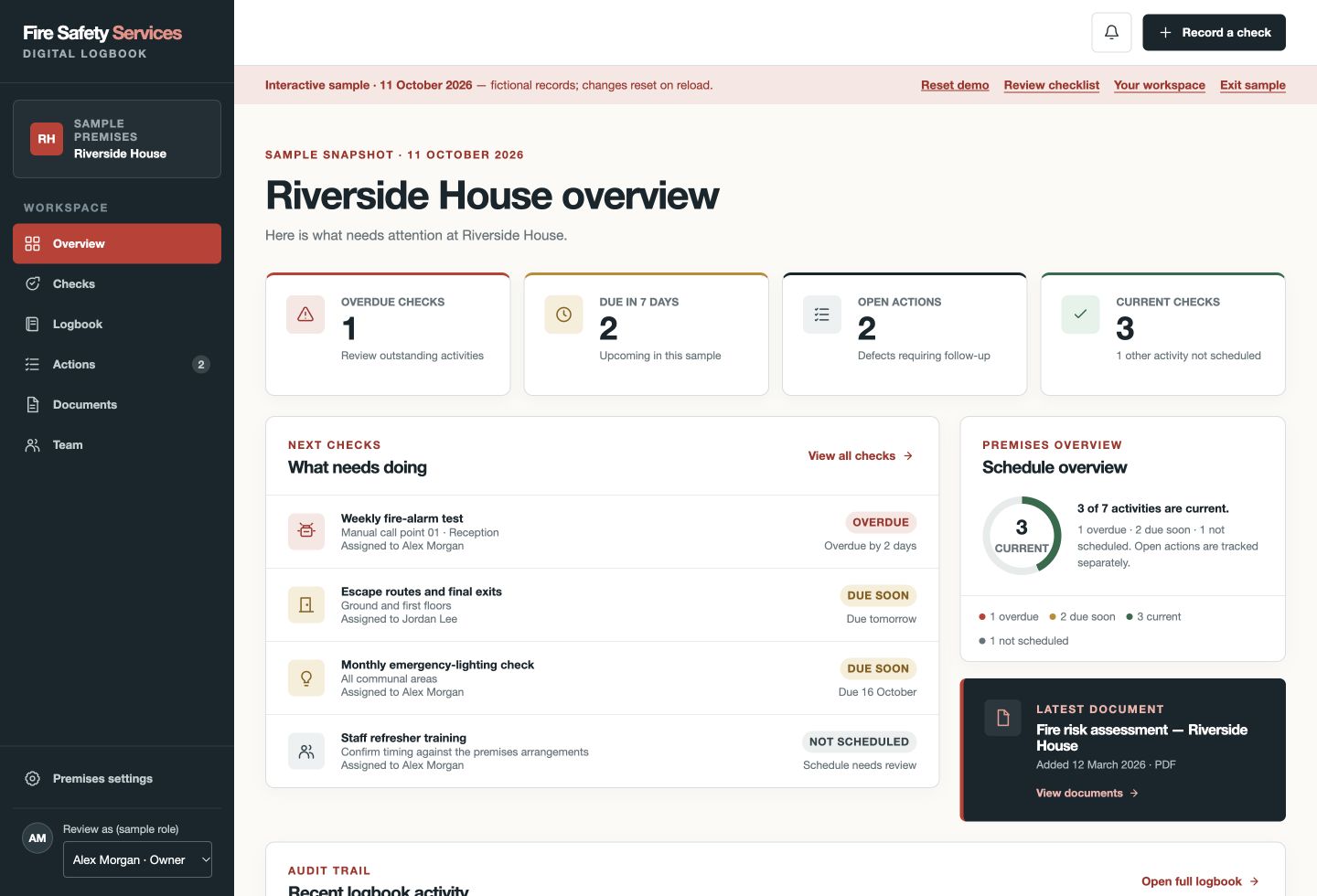
At a glance
The online product is available to UK users. This site’s fire-safety guidance primarily addresses England; apply the duties and system requirements relevant to your premises.
Practical record keeping
A useful fire door inspection log needs an unambiguous door location and an honest scope. Basic checks help notice deterioration; they do not determine a doorset’s fire-resistance rating, specification or suitability.
Record the date, checker, door ID and exact location. Identify the relevant side, floor or flat where necessary. Use a consistent reference so a later repair can be matched to the original observation.
Record whether the door closes fully and latches where applicable, following the appropriate procedure. Do not force doors, alter closers or interfere with hold-open equipment. Describe what happened rather than inventing a technical diagnosis.
Record observed damage, missing components, obvious alteration or other concerns within the instructed check. Mark aspects not checked as such. A simple visual observation does not verify hidden construction or certified performance.
State if access prevented part or all of the check. For flat entrance doors, keep the relevant attempts and access outcomes. An inaccessible door is not a satisfactory inspected door.
Describe the affected door and concern, the person notified and the immediate response. Serious closing or protection concerns need prompt responsible-person review and competent help, not just an action with a distant target.
Link the observation to inspection, repair and verification evidence. Keep the original condition record, later outcome and unresolved questions. A photograph alone does not establish the door’s fire resistance.
A record you can follow
This fictional routine observation records a failure to latch. It does not specify a repair or certify the door’s fire resistance.
Record the observed closing behaviour, visible condition and limits. Select Issue found; do not describe the whole doorset as certified or satisfactory.
Review the linked action and responsibility for competent assessment and repair. Record the immediate response and necessary follow-up.
Keep selected inspection or repair evidence on a paid plan. Record the verification of the outcome before resolving the action; retain the original failed check.
Download recorded checks and actions as PDF or Excel. Keep the door schedule, specialist reports and access records available alongside them.
Use the free full PDF/Word logbook for manual routine door records. The separate interactive fire-door checklist offers detailed observation prompts; neither it nor the app replaces a competent technical inspection.
One genuine entry free, without a card. Ongoing online recording and supporting evidence require a paid plan.
A fictional basic check shows how to describe a closing failure without diagnosing the repair or certifying the door.
Start without a sales call
Enable the relevant premises topic and identify the actual door or location. Follow the building procedure and the limits of the checker’s instruction.
Enter the closing/latching observation, visible condition and outcome. Use notes for access limitations, defects and immediate response; do not record unobserved items as passed.
An Issue found outcome creates a linked action. A paid plan supports ongoing checks and selected evidence; the recorded history and actions can be exported as PDF or Excel.
Create your account and save your first entry free. No card required.
Your digital fire safety logbook
A checklist identifies observations; it does not arrange a repair. Keep routine door-check records and corrective actions connected without replacing competent inspection.
Built for ongoing record keeping| What you need | Free Word/PDF templateManual records, managed by you | Digital logbookChecks, actions and evidence together |
|---|---|---|
| Routine fire-door observations | Keep the checklist and maintain a separate follow-up list. | Record observations and track linked corrective actions and evidence. |
| Follow up faults | Maintain your own action list and follow-up process. | Track corrective actions through progress, resolution and archiving. |
| Keep supporting evidence | Organise photographs and certificates alongside your documents. | Keep evidence with the premises and link it to records or actions. |
| Download your records | Printable PDF and editable Word template. | Full recorded logbook in PDF and Excel, plus JSON and CSV exports. |
New customer annual offer: £49 for your first year, then £59/yearor £5.99/month · per premises · automatic renewal until cancelled
Team access, supporting documents and photographs, optional reminders, and PDF/Excel exports.
Create your account and save your first entry free. No card required.
No card is required for your first genuine entry. Ongoing recording requires a subscription; the full fictional demo is included with your free verified account. A logbook does not replace an FRA, competent maintenance or the action your premises needs.
Know what the record does—and does not do
In England, the additional regulation 10 check duties apply to relevant residential buildings whose top storey is more than 11 metres above ground: communal fire doors at least every three months, and best endeavours for flat entrance doors at least every 12 months. Keep records of steps taken to check flat entrance doors, including failed access. This is not a universal interval for all commercial doors.
Being below that height does not remove the general duty to maintain relevant fire precautions. Set an appropriate regime using the FRA, door information, use and competent advice. Do not infer that no checks are needed from the absence of the additional residential interval.
Basic checks are not a substitute for assessing suitability or arranging competent repair. Check the provider’s relevant fire-door training, experience and scope. For accompanying FRA work, check applicable BAFE or NFRAR credentials separately; neither is by itself proof of competence for every door inspection or repair.
Before you choose
The full free logbook PDF and editable Word pack includes routine fire-door and escape-route records. Request it by email with subscription consent; you can unsubscribe from future subscription emails. It is not a specialist inspection report. Our separate interactive fire-door checklist provides more detailed observation prompts.
No. This guide explains the record and follow-through for routine checks. Our separate fire-door inspection checklist structures more detailed observations. Neither a completed checklist nor a logbook entry certifies fire resistance or replaces appropriate competence for inspection and technical decisions.
Record each check when carried out, with its scope and outcome. The additional England regulation 10 intervals for relevant residential buildings over 11 metres are at least quarterly for communal fire doors and best-endeavours annual checks of flat entrance doors. Other premises need a suitable regime based on the FRA and relevant requirements, not an automatic quarterly rule.
Record the door reference, the access attempt, outcome and further steps planned. The government guide requires a record of steps taken to check flat entrance doors under the applicable duty, including when access was not granted. Do not label the door as checked or satisfactory without the necessary access.
Promptly notify the responsible person and follow the premises escalation arrangements. The impact and necessary interim measures need appropriate review and competent advice. Save an honest Issue found record, but do not let entering or scheduling the action delay the safety response.
No. It records the door reference/location, closing and visible-condition observations, notes and result. It is not a doorset certification system, technical survey or automatic inventory. Retain the appropriate door schedule and specialist reports alongside your records.
Create an account and save one genuine premises activity free, without a card. This is one entry across the logbook, not one free entry per topic. Ongoing recording requires a paid plan: the new customer annual offer is £49 for your first year, then £59/year per premises, or £5.99/month per premises. Plans renew automatically until cancelled; no VAT is added. A verified free account also includes the full fictional demo.
Connected guidance
Get your premises started
Create your account and save your first entry free. No card required. Your verified free account includes the full fictional demo for practice.